AI Lead Qualification: How to Automatically Identify Your Best Prospects
Not every lead is equally valuable. A business might receive hundreds of inquiries a month, but only a portion of those prospects will actually fit its ideal customer profile — and the real challenge is identifying the high-potential ones quickly, before they've gone cold waiting for someone to get to them.
Traditional lead qualification depends on salespeople manually reviewing company information, industry, location, budget, requirements, prior interactions, company size and buying intent for every single lead — work that consumes real time and produces inconsistent decisions, since one salesperson might consider a lead highly qualified while another rejects the identical opportunity. AI-powered lead qualification makes the process faster, more consistent and genuinely scalable, and combined with CRM automation and workflow orchestration, a business can analyze incoming prospects, assign scores, route opportunities and notify the right salesperson automatically.
What AI lead qualification actually is
AI lead qualification uses artificial intelligence to analyze information about a prospect and determine how closely it matches predefined business criteria — company, industry, location, size, requirements, budget signals, intent, engagement — producing something like a score of 88 out of 100, a qualification of "high" and a routing decision of "sales." The score itself isn't really the point. The point is answering the question a sales team actually has every morning: which leads should we focus on first?
Why manual qualification doesn't scale
A company receiving 500 leads a month, with a salesperson spending just five minutes reviewing each one, is looking at 2,500 minutes — more than 41 hours — of manual qualification, and the problem only gets worse at higher volume. Under that kind of pressure, teams start taking shortcuts: prioritizing whoever replied first, whichever email looks interesting, a company name they recognize, or a plain guess based on incomplete information — and good opportunities get overlooked simply because nobody had time to look closely enough.
Inside the qualification workflow
A modern qualification workflow starts wherever a lead actually originates — a website form, a landing page, email, WhatsApp, an advertising campaign, a referral form, a CRM import or an API integration — and runs it through validation before AI ever sees it: does the email exist, is the phone number valid, is a company provided, are the required fields complete. Invalid or incomplete records get routed for manual review instead of wasting AI processing on a record that isn't usable yet. From there, the system checks whether the person or company already exists in the CRM, updating the existing record rather than creating a duplicate when a match is found.
Enrichment and AI analysis
Basic form information is rarely enough on its own, so the workflow enriches it with industry, company size, location, website, business description, technology signals and other approved business data — giving the AI enough context to make a useful assessment rather than guessing from three fields. From there, AI can do the part a rules engine genuinely can't: a submission like "we have 70 employees and currently manage customer communication manually through email and WhatsApp — we're looking for a CRM that can centralize customer records and automate follow-ups" gets parsed into industry, company size, the specific requirement, the WhatsApp integration need, the pain point, and an estimate of automation opportunity and buying intent — structured information the rest of the workflow can actually act on.
Turning signals into a score
A scoring model combines weighted signals into a single number — target industry might carry 20 points, company size 15, a genuinely relevant requirement 25, buying intent 20, target location 10 and engagement 10, adding up to 100 — with a lead landing somewhere like 86 out of 100 once every signal is factored in. The exact weighting isn't universal; it should be built from the business's actual sales data and ideal customer profile, not copied from a generic template, since what predicts a good customer for one business can be irrelevant for another.
Unknown should stay unknown
This is one of the more important principles in building a scoring system that people can actually trust: if company size is unknown, the AI shouldn't quietly invent a number to fill the gap. A field that reads "unknown" is more useful than one that confidently states "120 employees" when that number was never verified — the system needs to distinguish between what's known, what's inferred, and what's genuinely unknown, rather than blending all three into a single number that looks more certain than it is.
“"Company size: unknown" is a more honest answer than a confident, unverified guess.”
From score to action: business rules and routing
Once a lead has a score, deterministic business rules take over — 90 and above becomes high priority, 70 to 89 becomes qualified, 40 to 69 goes to nurture, anything lower goes to review — and routing follows the same logic, sending an enterprise lead to the senior sales team, an SMB lead to the SMB team, and an existing customer straight to their account manager, based on territory, industry, product, company size, score, existing ownership and rep availability. That combination is what closes the gap between a lead arriving and a salesperson actually picking it up.
What lands in the CRM
The CRM record can update automatically with the lead score, qualification status, industry, company information, requirements, an AI-generated summary, the lead source, the assigned owner and the next action — so a salesperson opens a record that already reads something like "growing UK-based business looking for CRM and WhatsApp automation, current communication is largely manual, strong alignment with our CRM integration and workflow automation services" instead of a blank form waiting to be filled in. A high-priority match can trigger an immediate notification naming the company, the score, the requirement, the strength of intent and the SLA the lead should be contacted within — put in front of the right person the moment it's identified, not whenever they next happen to check the CRM.
Qualification doesn't stop at the CRM
A qualified lead landing in the CRM is the start of the process, not the end of it. The workflow can create the sales task, log the contact attempt, and branch based on what happens next — updating the CRM if the prospect responds, or triggering a follow-up sequence automatically if they don't — so a qualified opportunity doesn't quietly go cold just because a first attempt didn't land.
Qualifying leads wherever they show up
The same pattern applies outside the web form. An email that reads "we're interested in rebuilding our existing CRM and connecting it with WhatsApp — can you provide an estimate?" can be classified as a purchase inquiry for CRM development with a WhatsApp integration and strong intent, and routed straight to a sales review. A WhatsApp conversation can be read for context, classified, scored and pushed into the CRM with a sales notification the same way, so a genuine opportunity doesn't sit unnoticed inside a messaging thread. A website AI assistant can even qualify a visitor conversationally — asking what they're looking to automate, which systems they're currently using, roughly how large their team is — turning a handful of natural questions into the same structured data a long form would have collected, with a far better completion rate.
A hybrid model: rules plus AI
AI doesn't have to replace traditional scoring — a hybrid model is usually stronger than either approach alone. A rule-based portion can award fixed points for company size, target industry and location, while an AI-driven portion scores intent, requirement fit and pain-point relevance, with both feeding into the same combined total. That split gives a business deterministic control over the facts it can verify and AI-based interpretation for the parts of a lead that were never going to arrive as clean data in the first place.
n8n as the orchestration layer
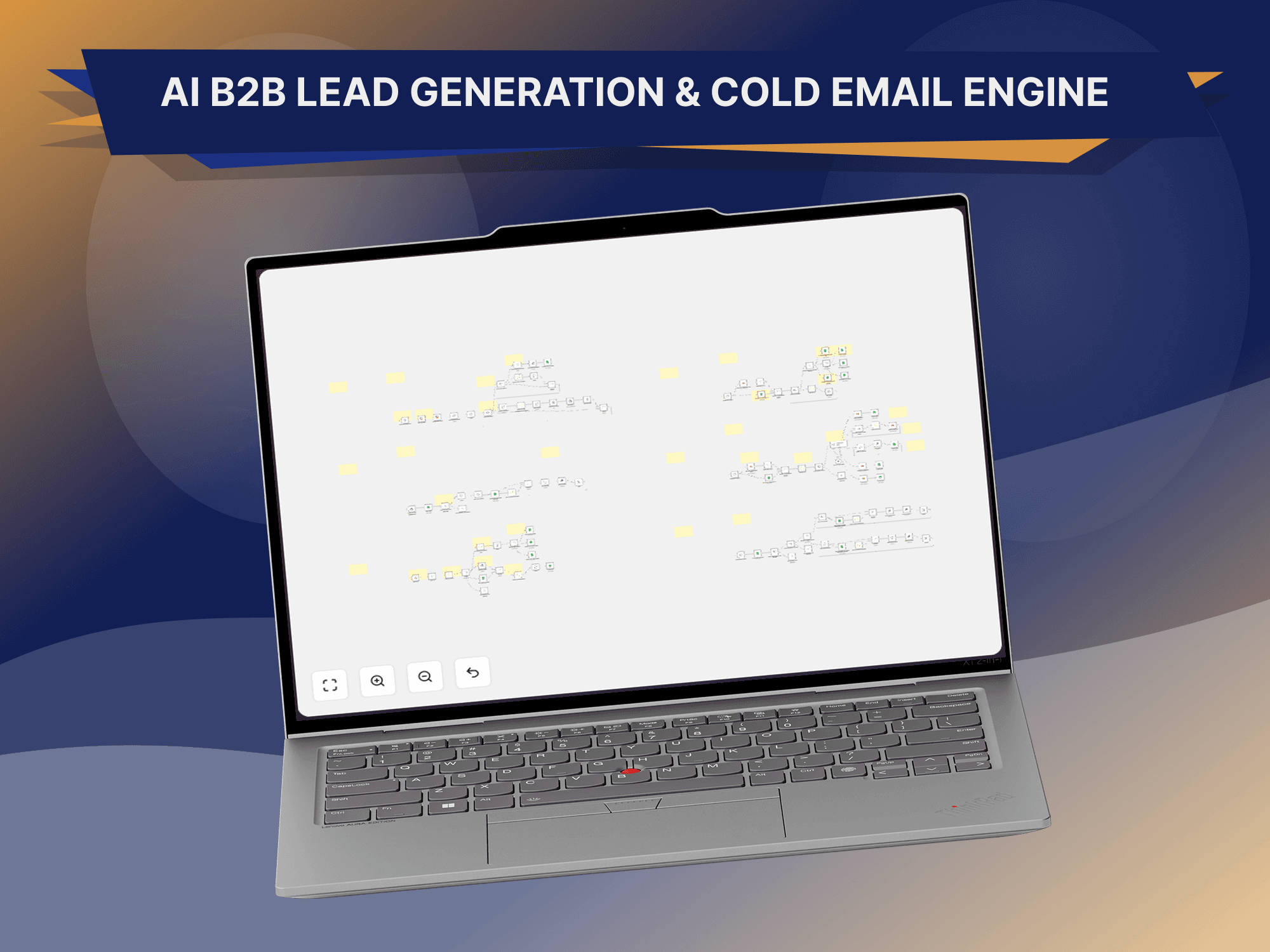
n8n typically sits at the center of this: a webhook receives the lead, an HTTP or API step retrieves enrichment data, an AI step analyzes the prospect, a switch or conditional step applies the qualification rules, a CRM step updates the record, and a notification step alerts the salesperson — one connected workflow rather than a set of separate tools each doing part of the job in isolation.
Giving borderline leads to a human
Not every lead should be automatically classified. A useful middle category — a score above 80 goes to sales, below 40 goes to nurture, and anything from 40 to 80 goes to human review — gives the sales team control over exactly the cases where a confident automatic decision would be a guess anyway.
Improving the model as real outcomes come in
A scoring model shouldn't stay static forever. Once enough historical data exists, a business can look at which leads actually converted, which industries and company sizes performed best, which sources generated real revenue, and which requirements correlated with genuine buying intent — then feed that back into the scoring rules. Lead data flows into AI qualification, qualification flows into a sales outcome, the outcome gets analyzed, and the qualification rules improve — a loop that keeps the model tied to what the business's own sales results actually say, rather than to assumptions made on day one.
What to measure
Qualification accuracy, sales response time, conversion rate, the rate of false positives (low-value leads wrongly prioritized), false negatives (valuable leads wrongly rejected), and the hours of manual qualification actually eliminated are the numbers worth tracking — together they say whether the system is genuinely improving the sales team's judgment or just adding a score nobody trusts.
Mistakes worth avoiding
The common failure modes are consistent: feeding the model too many signals on the assumption that more data automatically means better scoring, when only the signals that actually correlate with outcomes should count; letting AI guess at missing information instead of leaving it marked unknown; treating AI as the final decision-maker rather than an input business rules and people still control; ignoring historical sales data instead of using it to refine the model; and skipping human review entirely, leaving no path for the borderline or unusual lead that a scoring formula was never going to handle well.
Qualification criteria change by industry
What counts as a strong lead varies by business. A SaaS company might weigh company size, technology stack, existing software and use case; a real estate business might weigh property type, location and portfolio size; a healthcare organization might weigh organization type and operational needs; an e-commerce business might weigh store size, order volume and platform; a professional services firm might weigh team size, client volume and process complexity. The AI needs to be configured around a business's actual ideal customer profile — there's no universal scoring template that works equally well across all of them.
Lead qualification is one of the more valuable places to apply AI automation precisely because it sits directly between marketing and sales — the point where a raw lead either becomes a real opportunity or quietly gets lost. A well-designed system moves a raw lead into an enriched prospect, then through AI analysis into a qualified opportunity, then into a concrete sales action, with the CRM, the score and the routing all keeping pace automatically. That's the kind of system GitzTech builds — websites, CRM platforms, n8n, AI models, email, WhatsApp, lead sources, databases, APIs and calendars connected into one workflow that captures leads, enriches them, scores them and routes them to the right person, so the goal is never an impressive AI demo but a sales process that helps a team spend its time on the opportunities most likely to matter.
AI shouldn't replace sales judgment. It should give a sales team faster response times, cleaner CRM data, and more of their time back for the opportunities that are actually worth pursuing.
Common questions
What is AI lead qualification?
AI lead qualification uses artificial intelligence to analyze prospect information and determine how closely a lead matches predefined qualification criteria.
Can AI automatically score leads?
Yes. AI can produce structured scoring or recommendations, which can then be combined with deterministic business rules to decide what happens next.
Can AI qualify leads from website forms?
Yes. A website form submission can trigger a workflow that validates, enriches and analyzes the lead before updating the CRM automatically.
Can AI qualify WhatsApp leads?
Yes, where the appropriate WhatsApp Business or API infrastructure is in place.
Can AI lead scoring connect to my CRM?
Yes. Lead scores and qualification information can be synchronized with supported CRM systems as part of the same workflow.
Should every lead be automatically accepted or rejected?
No. A human-review category is often useful for uncertain or unusual prospects that a scoring formula alone shouldn't decide on.
Can the scoring model improve over time?
Yes. Historical sales outcomes can be analyzed to refine qualification criteria and improve the accuracy of the scoring process.